Harvey and the flying machine

Ahhh..I am so tired. But, a story I will tell you,  for your little ones.

Harvey, of rabbit fame, thought himself a rakish Jack of Knaves. Such a suave countenance should by no means go unheralded. He built himself up to be a legend in his own mind. “I am Legend”, he said, having heard that somewhere before. He made himself a hat of green felt with a snakeskin band and a feather stuck into it. “Hah! A feather in my cap! Always knew it!” he said, as he carefully fitted it and pulled it down over one eyebrow. Then, clapping his hands gleefully in front of his full length mirror, he gave his moustache a Dali twirl to complete the picture.

Just last night, he had had a dream in which a thing instructed him in the building of a contraption that would endow him with the freedom of flight. What is more, it suggested to Harvey that, if he embarked on his maiden flight at a certain hour on a certain night, he would gain the means to become The Power, and would rule over all the hamlet of Glynn, neatly nestled on the shady side of the mountain and down into the Valley of Dim.

As we know, Harvey was an excitable lad, and grandiose dreams such as this one do not happen all that often to us earthlings.  “Yes.  Yes!”, he said to himself.  “I can build the machine.  But what am I to do in the middle of some godforsaken night while putting around the rooftops of Glynn?”  Three more days went by, and The Date was but a week away, when Harvey was favored with chapter two of the machine dream.

The marvellous contraption, if built correctly, would provide Harvey with more lift and hovering power than he would need, and, best of all, it would fly in absolute silence.
That was important, as you shall find out in a minute.  The dream thing told Harvey that he was to build a small box of brass with a hinged lid that could be locked.  He was to take this with him on the flight.  “And, at three of the Wee” it said “Ye shall touch each tree.  And then, ye shall light on each chimiNEY.  Open ye box, collect a second of its smoke, see?  Close fast the lock on the lid, then go ye to the next, ’til all is done.  Aye, it is thirty and nine, hear me?  I’ll tell ye more, the night before.”

Harvey went into Glynn in his finest outfit, feather in hat, smiling and saying Halloo to everyone he met.  He collected all of the peculiar things he would need for his tinkering, and pedalled back home, pulling his little cart behind him.  By Caturday’s Eve, all was ready, and Harvey indeed was surprised and excited because he had piloted his “Dragonflyer” on a short maiden flight.  He went to bed early, without tea, for he knew he had to be alert and ready in the wee hours of the morning.  Besides, and more importantly, a dream story was yet to be told.

¶n the chimney smokes of Glynn (his dream master said) dwelt the darkest secrets of every man and woman therein.  Harvey’s box of brass would be the collector of those secrets, and he would hold The Power of their knowledge.  He need only speak discretely to a few of the townsfolk.   When it became clear that Harvey knew things, it would not be long before he could install himself as The Grandee of Glynn, or so he thought.

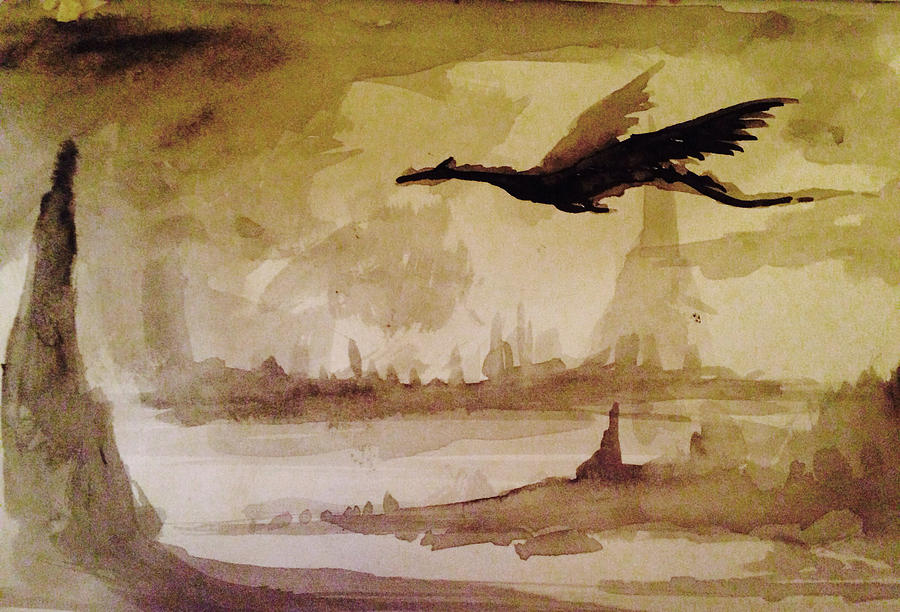
In the darkness of Caturday’s Eve, the flight of his Dragonflyer was true, and before dawnlight, Harvey’s deed was done.  All was still, until the mutterings of thunder were heard.  A seed of panic was planted in Harvey’s mind, and he set off homebound with haste.  But, as we know, persons who have bad intentions seldom succeed.  The dragon contraption flew as promised until the sizzling bolts of lightning shot their spears at the unfortunate pilot, and one could see his panicked progress in the strobelights of the storm.

All at once, a stray bolt struck the brass box! Harvey was stunned but not electrocuted, because of the thick gloves he had worn against the soot and heat of the chimneys. But the force of the bolt threw him and his box out of the craft, toppling them a hundred feet into a mound of hay bales by his barn. The dragon flew away, doing crazy pirouettes in the dawn sky.

Sore and disheveled, Harvey found the box and went into his house.  The box was still locked. He set it on his kitchen table, then decided to go upstairs for a much needed rest (even though it was broad day).

That same morning, while Harvey was snoring upstairs, the people of Glynn were waking up a little later than they usually did.  Their little children were, of course, up at their normal time, that being the crack of dawn, but they could not wake their snoozy parents until some time later.  That was because something curious had happened during the night.  For some reason, all of the Moms and Dads felt strangely light, as if a weight had been taken from their shoulders.  They were happier than they had been for many a year.  Of course, that was simply because not one of them could remember the secrets they once held, or the sins they might have committed.  When they went out into the streets, they greeted neighbors they had not spoken to for a time because of remembered grudges that were now swept away.

As for Harvey, well… he smelled smoke, and then he began to feel very peculiar.  Downstairs he went, to discover that the brass box had flipped its lid.  Its secret smokes had inundated his house, and he had already breathed in too much of them for his own good.  He ran for the door and threw it open, then the windows!  Harvey slumped into his old livingroom chair and, if you were a little mouse or a fly on the wall, you would have seen his eyes bulge, his hands quiver, and his head shake back and forth.  He muttered strange words that were like a foreign language, then ran out in his striped pyjamas.

It turned out that his flying machine had, after doing various accidental manoeuvers ,
fallen into the same pile of hay that had saved Harvey.  Still shaking and muttering in his blue pyjamas, he got onto it and took flight into the wild blue yonder.

Harvey was never seen again, and Pandora rolled over in her grave.
Ideations

She called me.
We went rushing
in two cars.
His promise was empty, though.
Passed out,
half on the floor,
half on the couch.

She smacked him in the face,
gently.
Put a cold cloth on his forehead,
and he sputtered awake.

We searched the house,
emptied all of the bottles.

Haha, he said.

I stuffed my hands into my jacket pockets,
and left.
She left in morning.

Until next time.


Dad’s wish

Dad’s been long in his grave.
We didn’t know each other, really.
At nineteen, I felt like a fake,
attending bedside vigils,
not knowing what to say or do.
When i got the call, I was silent.
Only silent.
Fifty years ago.

And now, I’m a year away
from living as long as he did.
In a bothered and quavering dream
last night,
I waited by the winter waterfall,
in a cove among dark pines.
I knew of his coming,
and kept an eye upslope
on the frozen bush road.
There were no night noises here,
and so I heard the crunch of his zip-up rubbers
just before he materialized.
It was Dad all right, with his white goatee,
dressed in an overcoat of black oilcloth
and his tweed fedora.
He was carrying things:
one of those flat aluminum saucers you had when you were a kid,
and, in the other hand, a dufflebag.
He came up to me, and set his things down.
He did not speak, but pulled out a pack of cigarettes,
lighting one for each of us.
I could not speak,
and withdrew my eyes from his.
We smoked for a minute or two.
He picked up the dufflebag
and led me by the arm down to the river.
There was a wooden bench there,
and he motioned me to sit.
Beside me he placed the bag,
then made a curious praying gesture.
Then he held up one finger,
in token that I should wait.
I watched him trudge back up the icy hill,
carrying his saucer.
A moment later, he came plummeting down the hill.
He was laughing, laughing.
My Dad was having FUN,
such as I’d never seen him do in life.
As he passed me, he was waving,
and I stood up suddenly.
He was going straight for the river.
In a second, he was gone.
I ran to the riverbank,
just as he went through the thin ice.
He was still waving, and smiled placidly,
making the OK sign as he sunk.
I knew he didn’t want to be saved,
for this was only a cartoon death.
At the end, I struggled with the meaning
as I sat down once more on the bench.
I unzipped the brown dufflebag,
and there was a mewing as I lifted out the black cat.
It was warm, and I gathered it to me,
but it wanted to look at my face.
Its eyes looked into mine and held me,
seeing more than I wanted.
Dad, I thought.
At last, the eyes relaxed,
with a seeming smile of wistful regret.
“Would you like a cigarette?”
I said.

Atop the moon’s ruined tower I stand.

There is no sky here,

and I can see the torrid Earth.

But you were not one of us,

and this I can’t share.

We have built her.

She is ready.

I must go

with the first planetary sailors,

or I must come back to you

for the short time left.

Sequestered

Darlene and Dave,
they had a love.
On grandfathered land,
they built a house of modesty,
high under the evergreens.

Neighbours flocked to raise the roof.
Each brought shingles, cedar shakes
of secret colours, ’til unboxed.
The coffee, the tea, the hot chocolate.
The joy. The laughter. The promise,
in that snowy October.

First came Darlene’s gardens,
with care-woven roots.
Then, a son and daughter, a year apart.
Never the holiday they took.
Never did they want for other lands.
But the boy and the girl,
they went to good city schools,
and soon they had a hankering.

With their earned degrees, they wanted the world.
There were stoic farewells, in time.
The house of modesty had a change in its airs,
too many spaces in its purpose.
And Darlene plied her trade in the summer gardens,
trying to grow what might fill.
And Darlene took a room
and made tapestries of delicate beauty.
Quilts that had no rival.
And Dave took a room
and tied fishing flies
and made soldiers and cannons of molten metals
and hammered copper story scenes for the walls.

And they did go to a hidden summer lake
to swim and to collect things that drifted.
And even after their middle age
they skated on that lake,
sequestered in the snow.

On a summer, Darlene was kitchen-bound,
baking for a lakeside lunch.
She wondered at the change in the timbre of the riding mower.
Dave never left it running, she knew.
Rinsing her floured fingers,
she went out the back screen door to call him,
but her Dave had died. His heart.
~~~~~~~~~
These ten years now,
I have delivered Darlene’s groceries.
Waiting on her visitors from foreign lands,
she was soured to the world.
Took up with the smoke and with the drink.

Today, as I drive the muddy road,
I have a companion with me.
The nurse that will tend to my old friend.

The cedar shakes of the bowed roof
still show a checkerboard of colour,
even in this grey streaming rain.
I have always thought that each one was signatory
to a day in the lives of those two.
A smattering of their joys, their fights, their triumphs, their sadness.

Darlene had called this morning
to tell us not to knock.
To just come in the front door,
take off our wet boots.
She sits in the back living room now,
in a fluffed robe,
with her tobacco.
Sequestered from the gloom,
but part of it, too.

Steel and glass

Just today, 55 years after the crash, Stuart’s face has appeared to me once more in a dream.  I don’t know why I remember this, especially now, in my 69th year, but it feels as if God has spoken to me about one of his angels.

On December 27th, 1964, I was fourteen and my brother Mark was eleven.  “Stewie” had been Mark’s only friend since he and his parents had moved into our apartment building, some four years before.  Being probably the eldest kid in the building, I had been busy recruiting followers (all younger kids), setting trends with my Beatle Boots and Fabian haircut, and developing an interest in those strange creatures, the Gurlz.  All of this, though, did not prevent me from feeling a streak of jealousy over the time Mark and Stuart spent together.

Sophie was Stuart’s mom, and they lived down the hall from us.  I don’t have much of a memory of his dad, as he seemed to be away most of the time.  Sophie worked as a part time secretary, I think, and Stuart would come to our place for a few hours while she was gone.  With his round doe-like eyes and a lower lip that drooped into a perpetual pout, Stuart’s face was meant for a mother to love, and indeed he clung to Sophie whenever we saw them together.  He may have been the shyest person I have ever met.  Being a little younger than my brother, Stuart was a willing disciple when Mark began to school him in the basics of rebellion.  Nothing serious came of it, but whenever trouble bubbled over, Mark was one of the suspects.

Stuart and his family had lived in our building going on five years when they had to move away because his father had gotten a new job.  Mark was unhappy, of course, until Sophie started to bring Stuart for visits almost every weekend.

There was a new kid named Stanley.  He and his family had moved into an apartment on the top floor of our building, and he always took the stairs when coming outside.  Three flights, and he made a game out of running down them as fast as he could.  At the bottom landing, there was a heavy glass door that you had to push open, then a few steps outside to the pavement.  To the left of that door was a tall and narrow window made of frosted glass.  I assume its purpose was to let in additional light, while improving the esthetics of the place.

This window had been broken by some kids playing ball, and all that was done was to remove the shards of glass from the frame so that no one would get hurt.  Apparently, they couldn’t get it repaired right away because it was the weekend.  Someone had put strips of tape over it to show there was no glass, but this didn’t last long.  Once Stanley found out, his stair game became even more fun because now he could run right outside without stopping, making a beeline for the missing window.

On the following Monday, the repairmen were there first thing and put in the new one, this being of clear glass because they couldn’t get hold of the frosted stuff right away.
Mark and Stuart and I were having lunch on our second floor balcony when we heard the crash and Stanley’s screams.  He had played his stair game one too many times, and had run clean through the plate glass window.  My mother rushed out to see him laying in a pool of blood and went yelling down the hall for help.  Women came out with towels to help bind him up.  We went inside on mother’s instructions.  Mark and I were stunned. Stuart just buckled, sat on the floor, and cried.  Stanley wasn’t even his friend.

In the next week or two, while Stanley was still in the hospital, we didn’t see Stuart. Sophie had called to say that he was too upset to go anywhere, and so she stayed home with him.  I felt that the accident was partly my fault for not telling anyone about Stanley and the stairs, but it took me a while to open up about it to my mother.

A couple of weeks before Christmas, after Stuart had spent a sleepover at our place, Sophie came to pick him up, saying they would see us between Christmas and New Years.  And so they did, the day after Boxing Day.  We had presents for Stuart, and they stayed most of the day with us.  The next day, Mark and I were outside playing street hockey. When we came in to get warm, Mom was sitting by the kitchen telephone crying.  She hung it up and motioned for us to come to her.  Stuart and Sophie had been killed  by a drunk driver after they left our place on the previous night.  Mark started crying.  I think I was silent.  Stuart was a true friend, and the purest soul I had ever met.

As I write this, I think that young face was in my dream for a reason.  I have gotten too far away from purity, if I ever had such a thing.  Stuart wasn’t even family, but when I think of what the knives of the world did to him, and of how short his life was, I feel humbled and ashamed that more of us cannot hold onto some of that kind of innocence. So Stewie, know that you are remembered, and held in love.