One track mind

Tell out loud
how good coffee lingers
like nicotine fingers.
Remember now
how a curly head kid
had to keep up with Dad,
no proffered hand,
in a strange land
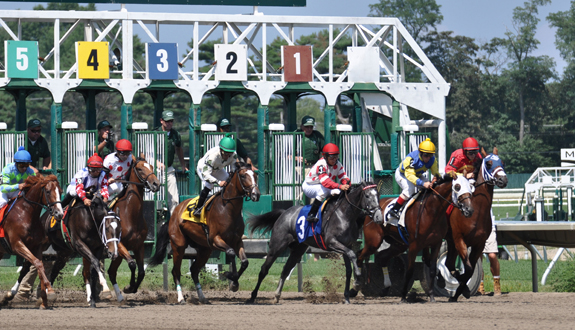
of cigars and racing forms.
*Outta my way, kid.*
And men behind wickets
spat out the tickets
but seldom gave us money back.

And now, coffee cooling,
I think of tag-along days that are long gone.
And I remember how Dad always smelled of cigars,
though he never smoked one.
And how I came home from those days of loss
to a crying mother
and fights in the kitchen.

Waste not, want not

For his end time,
we flocked together from our compass points,
and gathered by his bedside.
Like the fresh faces on Auntie Em’s farm
after Dorothy’s dream.

In his life, he must have dreamt us
into something that held him happy
until this day.

His plugs and wires and tubes
seemed connected to an underground cloud,
and what it fed to him was bitter.
Today was his day for the punching of tickets,
like Tom Hanks on the Polar Express.
But, inspirational? Not so much.

Each one showed our other face
just as we were looking at his,
and we wanted to plug our ears
as he spewed secrets
that we dismissed as drug-induced,
but knew to be true.

And what do you do with the Never Dids,
the filthy kids and the hiding hids?
The thrown cans of salmon
and the smashing plates.
Oh God, we were sorry,
and a group hug just wasn’t in the cards.

Hero

A scene of old develops and sharpens.
It’s the start of some chapter
in a boy’s learning.

This memory is of being ten.
It has cold misty rains at a train station.
The buying of a ticket
with nickels and quarters and wide eyes.

He is going to see El Cid in Montreal
by himself, with given permission,
maybe implied good riddance,
and certainly a flight to something
contrived, but noble.

It’s a way to forestall fear for the future.
To puzzle out why close people fight
and bury the fallout;
to feel the budding of self-assurance
and, finally, to admire a hero
whom all would love and despair.

Yes, he wanted to be
someone’s hero.

My Man

hunch up those shoulders
carry that hollow barrel chest
on spindly trembling legs
practice your ghostly motions
stare obscenely out of eyes like yellowed olives
your gates are closed for good
and i stand
holding you up
listening to disconnected mutter
while you piss black tar
dribbling onto the floor
and you say “I’m sorry”
my man
oh my man
there’s a hole in my heart.

Gifts of today


In yard-high drifts,
the small chittering tracks of a resident rabbit,
filling in  quickly with the blowing snow.
I follow, stupidly bootless,
right around the house
until I see where it shelters.
Our spreading birch, in this blizzard,
shows out as a sketchy charcoal drawing,
and our miserable cat stares out
from the orangey warmth of the living room.
I plod up to the glass door, open it,
and ask my wife for carrots and lettuce.
Are you hungry?…she says.

a failure of foresight

Don’t kill yourself, (they said),
when he went out to do the walkway
in the dark.
One upstairs, with Netflix on the headphones.
The other snoring in her pillow chair.
Most of the neighbourhood in for the night.
The odd car, trucking bags of groceries
or kids to piano lessons.
So no one found him, behind the boxwood hedge,
until the movie credits rolled
and the sleeper woke with an itchy premonition.

Apartment for rent

Erica has her own key
to her own apartment,
on the strength of a job letter.
No more nightly pay,
unwanted bottles,
fancy but fouled dresses.
She sits in the arbourite kitchen
with a half jar of instant
and ten cigarettes.
As a spotted pigeon taps the window,
Erica takes stock.
Of unfinished school,
desperate and frustrated parents,
bad associations.
This donkey’s education.
Soured to life, in the age of exuberance.
Phantom Facebook friends.
It’s so silent in here, she thinks,
and walks, perplexed, to the window
with a finger full of peanut butter.
Bird must be hungry,
’cause it pecks like a jackhammer
and hurts her finger.
She draws back in fright.  It flies away in fright.
What now?  She thinks.  Not a soul, not a soul do I have.
An apartment she has.
And an apartness.  A leper’s loneliness, tonight.


Memento

When they went to clean out the dead man’s room, one could see their noses wrinkle from the smell of his cigar years.  There was sweeping and wall washing to be done, but the first thing was to get that stuck window open.  Brother John was dispatched to the hardware for a crowbar.  Their old man had really been a slob.  Floors, furniture, and nearly all other surfaces were rimed over with a thin coating of smoke-embedded grease, and the tile floor was cracked and puckered.

A fold-up easel leaned against the wall by a closet door, and a battered metal case stood beside it.  Since his retirement at age 60, Henry and his loosely-knit family had fallen away from one another.  When it became clear that all he wanted to do was smoke and paint, mother had cut her losses and ran. Henry took this dim little room above a second-hand store. He had enough money to provide each of them with a meagre living and to buy himself unhealthy food and have it brought to him.

And he painted.  Once a month, in summers, he would slide some of his canvasses into the back of his Ford pickup, and set up shop in the pothole parking lot of a small plaza. His stuff was different, oddly pleasing, and a cut above what you would find at Woolworth’s or Kresge’s.  John and Sheila had seen his work, and thought it strange but mediocre.

This night, as they aired the place out and began scrubbing, Henry’s landlord came to the door to see how things were progressing.  Sheila asked him if he knew of a key that their father might have kept for the lock on his closet door.  “No, and that will need fixing too, once you get it off. And no, I don’t have no bolt cutters.”  John nodded, and made another trip to the hardware store.

The deed was done, and the door creaked open with a musty smell.  Dad’s old football jacket, a beanie, some mitts, and a pair of snow boots.  A half dozen shirts that looked as if each might have been devoted to a day of the week, and one worn twice on weekends. And, on the floor in the darkest corner, some rectangular bundles wrapped in towels and tied with twine.

The two kids, having no tools of their own, used the bolt cutters on the heavy string.  When they unfolded the towels, they found Henry’s treasures.  Three paintings as real as photographs.  The first depicted a man’s shirted shoulder, and his hairy arm with a rolled up sleeve.  A leather belt dangled from his fist. In the background was a blurred shadow.  A small figure cowering on the floor with its hands protecting its head.  The second, in stark relief, was of the man’s fist, held up in a threatening manner. A gold signet ring leered back at the viewer.  John and Sheila knew that ring.

The last was a portrait of a boy, barely into his teens.  His bruised face and contorted mouth told all that was needed.  The boy was Henry.  Besides his cuts and bruises, he had one other thing to remember his father by.

***

Photo by Brett Hurd.
Ember month

Sundown at Nipissing’s shoreline,
and the big lake begins its freeze.
The soft fire of November’s embers
pleases the eye, but can’t warm us.
I stand in the cold cold sand
that waits for winter’s cover,
and think of unimportant things:
that there will be no more drifting things,
maybe until June.
And, where do all of those greedy gulls go
when the freezing squalls begin?
And, another question, for old Dad:
You sure liked your hot mashed potatoes
with that half stick of butter,
table cream,
salt & pepper.
Why can’t we eat what we like, Dad?
Without dying, I mean.
I just can’t…
no more.